

Montagne Sainte Victoire


Why climb in Sainte-Victoire ?
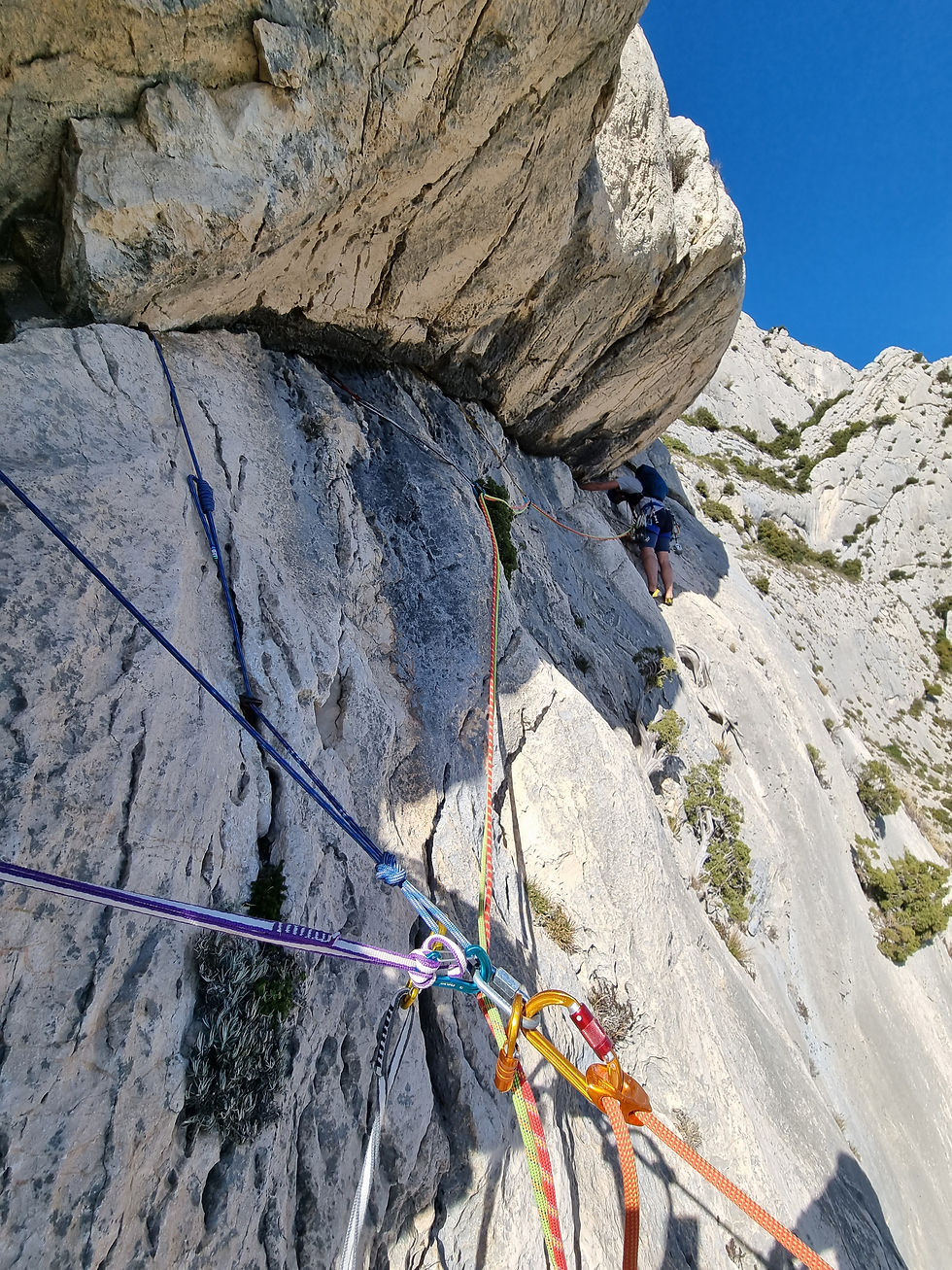
Sainte Victoire has a style of its own. The rock is compact, holds are scarce, and the slabs demanding. Far from the airy limestone of the Calanques, climbing here requires precision, reading the route, and patience. It is a historic site, first explored by pioneers in the 1970s, which still carries an old-school atmosphere that visiting climbers recognise immediately.
Some recommended climbs :
"Les Deux Aiguilles" – (Single pitch aera) Come develop your skills on these technical limestone slabs and if you feel like it experience famous routes established by the pioneers in the 70s.
Le grand parcours – (530m, 5c+); Ascend the entire length of the full face. This classical trad route is an elegant way to reach the summit. It feels like an alpine course.
La marbrière – (180m, 5c); A beautiful route that offers a great introduction to the climbs in the massif.
Our Activities:
.jpg)

Intro to Sport Climbing
Montagne Sainte Victoire
3h30
200€
.jpg)
Practical Information
Seasons
Sainte-Victoire faces south, which makes it one of the sunniest winter climbing spots in Provence and one of the least practical in summer. From June to September, the heat makes climbing at most sectors a bad idea. From November to May, cold clear days often offer excellent conditions: dry rock, Provencal sunshine, and the kind of cold that makes limestone grip even better. This is a spot for winter performance climbing. Although be warned that most sectors are fully exposed to the Mistral, which can make for an interesting (and freezing) experience. Like all massifs in the Bouches-du-Rhône, access is regulated during periods of high fire risk.
Access
Most sectors are reached from the parking lots at Plan de l'Anchois or Les Deux Aiguilles, on the D17 (Route Cézanne) between Aix-en-Provence and Puyloubier. The approaches range from 15 minutes to an hour depending on the sector. The Refuge Cézanne is a useful landmark for navigating between itineraries. Unlike the Calanques or Cap Canaille, there are no access rappels here. All approaches and descents are by foot.
A world apart
Sainte-Victoire is well known to local climbers from Aix and Marseille but largely off the radar for the rest of the world. Its hundreds of trad routes, opened between the 1960s and 80s, see very little traffic today and some haven't had a repeat ascent in years. For climbers looking to train on rock away from the crowds, build trad skills, or prepare for alpine ridge routes, this is a great area to do that: 40 minutes from Marseille, 20 minutes from Aix.
Route Selection
Technical slabs, mountain-style ridges, historic trad crack lines: Sainte-Victoire offers a style of climbing that's rare in the region, which involves demanding precision and footwork, route-reading and a love for slab. Here's a selection of routes in roughly increasing order of difficulty.
Climbing at Les Deux Aiguilles
Les Deux Aiguilles · Up to 90m · Single-pitch crag
The essential spot for working on your slab technique on outdoor limestone and for getting a feel for the rock before committing to a longer route. Here there are historic trad lines that build character that sit alongside better-bolted modern routes. Grades run from 4a to 8a+ (La Boule, freed by Patrick Edlinger), so there's a bit of something for everyone.
La Marbrière
Socle de la Carrière · 5c max · 180m
A nice, fairly long route that makes an great introduction to climbing on the massif. It’s a logical choice for those seeking an accessible climb, and oftentimes the first multi-pitch for many at the Sainte-Victoire.
La Géorgie
Socle de la Carrière · TRAD
A trad route in pure adventure terrain. Rarely climbed, modest grades, very much in the old-school Sainte-Victoire spirit. A good stepping stone before tackling more complicated routes on the massif.
Le Matchou & Le Pitchou
Saint-Ser · 5c max · ~100m each · TRAD
Two trad routes in the slabs of the Saint-Ser sector, opened in the 1970s and barely touched since. Both follow a system of cracks where gear placement is relatively straightforward and the climbing is never overly sustained, which makes them them ideal for building trad experience in an untouched, wild setting.
Moussaillons + Arête du Jardin + Arête SW de la Croix
Baou Cézanne · 5b max · 400m · TRAD
One of the classic links of Sainte-Victoire: 400 metres of mountain-style climbing leading straight up to the Croix de Provence that overlooks the mountains at elevation of 945m. Use slings, wires and cams throughout. This is a full day climb where you get to experience alpine climbing but at Provencal elevations.
Le Grand Parcours
Les Deux Aiguilles · 5c+ max · 400m · TRAD
This is THE mythical multi-pitch of Sainte-Victoire, which involves climbing the entire face from the base to the Signal at 969m. 400 metres of trad, with a walking section mid-route that allows for a bail point if needed, and keeps the overall level of commitment relatively manageable. Descent by the red trail or black path. Allow for a full day.
La Commande
Baou Cézanne · 6b max · 400m
The longest bolted route on the mountain, climbing the full face to arrive, quite literally, inside the Prieuré at the top. A few ledges breakup the continuous line along the way, but the final three pitches more than make up for it: classic Sainte-Victoire slab climbing followed by moves on a steep wall. Descent by the red trail. This is a long day so be sure to wear comfy climbing shoes.
La Constitution
Paroi de la Vierge · 6c max · 200m
A sustained bolted route that starts on technical slabs before getting steeper into a thin crack finish that demands a real effort to unlock these moves. Getting to the base of the route is just one part of the journey so make sure to allow for at least an hour for the approach. It’s worth every step!